
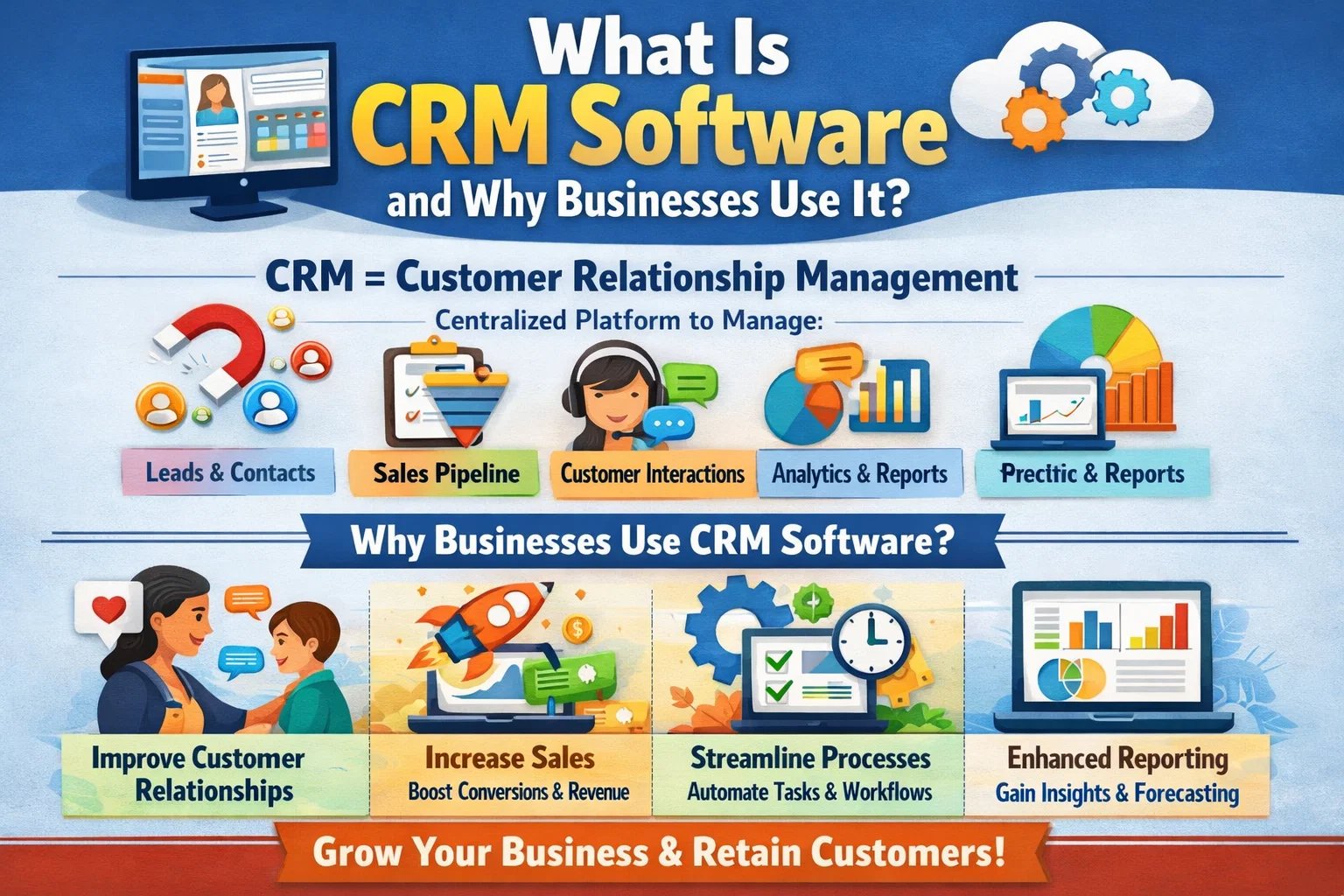
In today’s highly competitive digital economy, managing customer relationships effectively is no longer optional—it is critical for business survival and growth. This is where CRM software comes into play. Businesses across Tier-1 countries such as the United States, United Kingdom, Canada, Australia, and Western Europe rely heavily on CRM systems to streamline operations, improve customer experience, and increase revenue.
This comprehensive guide explains what CRM software is, how it works, the different types of CRM systems, and why businesses of all sizes—from startups to global enterprises—use CRM platforms to gain a competitive advantage.
What Is CRM Software?
CRM stands for Customer Relationship Management. CRM software is a technology solution that helps businesses manage interactions with current and potential customers by organizing data, automating processes, and improving communication across sales, marketing, and customer support teams.
At its core, CRM software acts as a centralized database where customer information such as contact details, communication history, purchase behavior, and preferences are stored and analyzed.
Why CRM Software Is Important in Modern Business
- Improves customer retention and loyalty
- Increases sales conversions
- Enhances customer service quality
- Provides data-driven insights
- Automates repetitive tasks
How CRM Software Works
CRM software collects data from multiple touchpoints such as websites, emails, phone calls, live chats, social media, and offline interactions. This data is structured into real-time customer profiles accessible to sales, marketing, and support teams.
Advanced CRM platforms also use artificial intelligence (AI) and machine learning to predict customer behavior, recommend next actions, and optimize sales pipelines.
Key Features of CRM Software
1. Contact & Lead Management
Stores detailed customer profiles including contact information, company data, and interaction history.
2. Sales Pipeline Management
Tracks deals from lead generation to closure so no opportunity is missed.
3. Marketing Automation
Automates email campaigns, segmentation, and customer nurturing workflows.
4. Customer Support & Ticketing
Manages complaints, tickets, and service requests efficiently within one system.
5. Analytics & Reporting
Provides real-time insights into sales performance, customer behavior, and ROI.
Types of CRM Software
| CRM Type | Description | Best For |
|---|---|---|
| Operational CRM | Automates sales, marketing, and service processes | Sales-driven businesses |
| Analytical CRM | Analyzes customer data for insights and forecasting | Data-driven enterprises |
| Collaborative CRM | Improves communication across departments | Large organizations |
Why Businesses Use CRM Software
1. Increased Sales and Revenue
Helps teams prioritize high-quality leads, shorten sales cycles, and close deals faster.
2. Better Customer Experience
Complete customer history enables personalized and consistent engagement.
3. Improved Customer Retention
Nurtures long-term relationships, which is more cost-effective than acquiring new customers.
4. Data-Driven Decision Making
Analytics improve forecasting, planning, and strategic decisions.
5. Workflow Automation
Reduces manual work, boosts productivity, and minimizes errors.
CRM Software for Small vs Large Businesses
Small businesses primarily use CRM to manage leads, automate follow-ups, and organize customer data. Enterprises depend on advanced analytics, deep integrations, automation, and scalability.
Cloud-Based vs On-Premise CRM
Most modern CRM solutions are cloud-based, offering remote access, automatic updates, scalability, and lower upfront investment compared to on-premise systems.
Popular CRM Software in Tier-1 Countries
- Salesforce
- HubSpot CRM
- Zoho CRM
- Microsoft Dynamics 365
- Pipedrive
CRM Software Pricing Models
CRM pricing typically depends on features, number of users, integrations, and deployment type. Subscription-based SaaS pricing dominates Tier-1 markets.
Common Mistakes Businesses Make with CRM
- Poor user adoption
- Overcomplicated workflows
- Lack of proper training
- Ignoring data quality and maintenance
Future of CRM Software
The future of CRM lies in AI-driven personalization, predictive analytics, omnichannel engagement, deeper automation, and intelligent customer insights. Businesses adopting these technologies gain a strong competitive advantage.
Final Thoughts: Is CRM Software Worth It?
CRM software is no longer a luxury—it is a necessity for businesses aiming to scale, strengthen customer relationships, and increase profitability. Whether you are a startup or a multinational enterprise, investing in the right CRM can transform operations and drive long-term success.
By understanding what CRM software is and why businesses use it, organizations can make smarter technology decisions in an increasingly customer-centric world.